


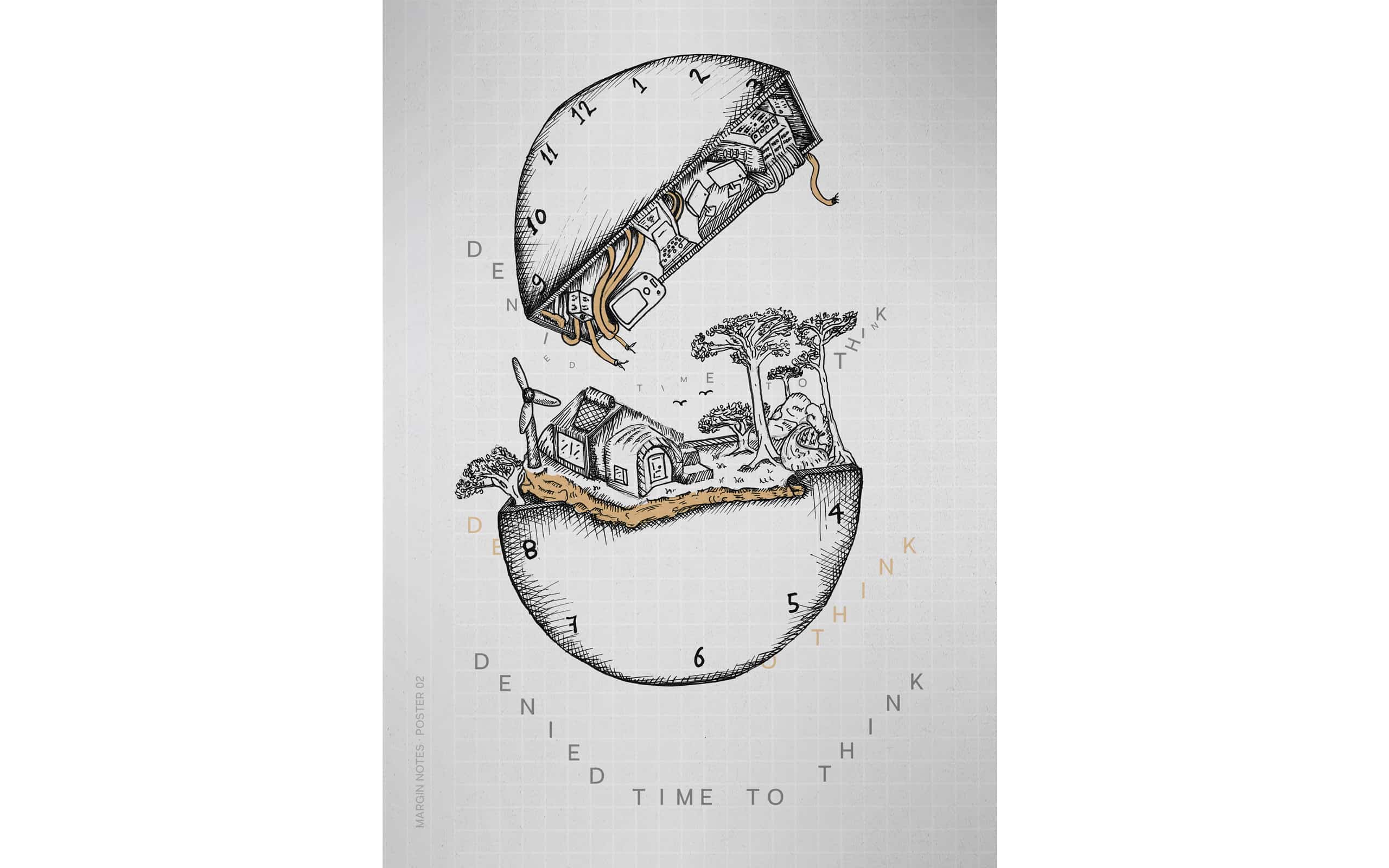
Denied time to think
I was sitting in front of a render queue, working for a fast-paced agency in Santiago de Chile, where I was a motion graphic designer and much of the post-production pipeline passed through me — in short, I was in charge of designing and producing many recurring media segments, mostly for large corporate clients. Much of that workload went toward internal communications for human resources departments across major mining and telecommunications companies. It was a fast-paced working environment where efficiency in production volume was prioritized over crafting quality — and it had good enough reason to be that way.
I quickly realized I was doing a much better job, delivering all our scheduled jobs on time — and that only gave them a reason to pile on more workload, despite it being common practice in Chile not to pay overtime or offer a binding employment contract.
A sharp contrast came when I landed in Ecuador and completed my first Permaculture Design Course, held in Vilcabamba by Zia Parker and her husband, Roshni McEldowney — she a permaculture teacher and designer originally from Boulder, Colorado, teaching the course since 1991. Their course draws people from around the world to Vilcabamba every year to learn design — a very particular kind of it.
It amazed me to learn how much time a proper observation phase alone demand
attention to terrain levels, geography, rainy-season behavior, soil stability, and much more. For Zia and Roshni, that meant three years of visiting the parcel in the Vilcabamba mountains, observing and watching the weather, the environment, and the community before arriving at the right design — one that would guide the planning and execution of their home, along with the school facilities for the PDC. The permaculture setup is a closed one: no waste is created, and no space is even defined for garbage. It was a remarkable experience, one that settled things for me against the fast-paced life of working for big corporations, advertising agencies, and media industries.
As new technologies have emerged to help optimize design, it’s become clear that more design, content, or ads don’t necessarily make a brand more effective. Observation and research, as part of the design process, have been neglected more and more; this century has seen much of graphic design funneled into the insatiable appetite of social media content. The digital era does have its upsides for environmental protection, though new technologies have also revealed a water and electricity appetite that is staggering.
Other design disciplines — editorial, industrial, product, interior, or automotive — may have had better alignment with new technologies, allowing them to scale while remaining more rigorous. Because digital goods are far less costly to produce, you won’t see the same kind of spike in editorial products, or a surge of innovative products, new furniture, or interior projects never seen before — disciplines that still draw on authenticity rather than quantity, unlike what has happened with graphic design in today’s over-digitized virtual world.
Let me be clear: profits drive business growth, and that is always a positive outcome for society as a whole. But it is equally true that shareholders demanding ever more profit, purely for profit’s sake, does nothing to help a company’s image within the community it operates in. The same question applies to how new technologies are leveraged — where are the benefits for the community that would, in turn, benefit the business in the long run?
Attention spans really are growing shorter — not by the apocryphal ‘shorter than a goldfish’ measure marketers love to repeat, but by real ones. Gloria Mark, who has spent two decades measuring how long people hold focus on a single screen, found the average span fell from two and a half minutes in 2004 to roughly forty-seven seconds today, a decline corroborated by five independent studies between 2014 and 2020. Which makes me wonder: what comes next?
Graphic designers have had to cope with an insane amount of expedited requests — yes, the worst design is the one that never arrives by the deadline — but no design communication is truly effective for long-term brand-building unless it has gone through a process of creative thinking: beginning with observation, looking at what already exists, then crafting new, appealing graphics, so we don’t dive into the sea of sameness.
So here is the promise I make myself: I will push back — on deadlines that make no sense, on goals nobody bothered to set, on a client’s request to shrink the only time meant for crafting the visual and the message. As I did once, when I found the courage to push back against the account executive who was about to pile on more workload — and still ended up rushing the tasks anyway, because to them, speed mattered more than the craft. It will cost deals. It will cost speed. Some weeks it will be the least efficient decision available to me. But it is the honest one — the same three years Zia and Roshni spent watching a hillside before laying a single brick, compressed into whatever room a deadline still leaves me. No waste. No space defined for garbage. Nothing hidden in what a piece of work actually took to make.

Leave a comment